Indonesian Green Coffee Grading System (SNI): A Complete Buyer's Guide
When international buyers source green coffee from Indonesia, one of the first questions they encounter is: what does the grade actually mean? Unlike the SCA specialty scoring system most roasters are familiar with, Indonesia uses a national standard — SNI (Standar Nasional Indonesia) — that grades green coffee primarily on physical defects rather than cup quality.
Understanding this system is essential for anyone importing Indonesian green beans. It tells you how clean the coffee is physically, what defect tolerance to expect, and — crucially — where Fine Robusta fits within and beyond this framework.
What Is the SNI Grading System?
SNI is Indonesia's national standardisation body, and its green coffee standard (SNI 01-2907) has been in use for decades. The system classifies green coffee into six grades based on a defect value — a weighted count of physical defects found in a 300g sample.
Each type of defect carries a different score. Primary defects (like black beans, mouldy beans, or insect-damaged beans) carry higher values than secondary defects (like broken beans, shells, or husk fragments). The sum of all defect values in the 300g sample determines which grade the lot achieves.
The Six SNI Grades
Indonesia's SNI standard defines six grades, with Grade 1 being the cleanest and Grade 6 being the most defect-tolerant. Here is the full breakdown:
| Grade | Max Defect Value (per 300g) | Moisture Content | Typical Use |
|---|---|---|---|
| Grade 1 | 0 – 11 | Max 12.5% | Specialty / Fine Robusta / Premium export |
| Grade 2 | 12 – 25 | Max 12.5% | Quality commercial export |
| Grade 3 | 26 – 44 | Max 12.5% | Standard commercial export |
| Grade 4a | 45 – 60 | Max 12.5% | Commodity blending |
| Grade 4b | 61 – 80 | Max 12.5% | Commodity blending |
| Grade 5 | 81 – 150 | Max 12.5% | Low-grade commodity / domestic use |
| Grade 6 | 151 – 225 | Max 12.5% | Lowest grade / local processing |

Primary vs Secondary Defects
Not all defects are equal. The SNI system divides defects into two categories, each with different weighted values:
| Defect Type | Category | Defect Value |
|---|---|---|
| Black bean (full) | Primary | 1 bean = 1 value |
| Sour/fermented bean | Primary | 1 bean = 1 value |
| Mouldy bean | Primary | 1 bean = 1 value |
| Insect-damaged bean (severe) | Primary | 5 beans = 1 value |
| Parchment bean | Secondary | 5 beans = 1 value |
| Immature/withered bean | Secondary | 5 beans = 1 value |
| Broken bean fragment | Secondary | 5 fragments = 1 value |
| Shell (husk fragment) | Secondary | 5 pieces = 1 value |
| Small twig/stick | Secondary | 5 pieces = 1 value |
| Black bean (partial) | Secondary | 3 beans = 1 value |
| Insect-damaged bean (light) | Secondary | 10 beans = 1 value |
Screen Size Classification
Alongside defect grading, SNI also classifies beans by screen size — the size of the hole (in 64ths of an inch) through which beans are sorted. Larger screen sizes generally indicate larger, more developed beans.
For export-quality Robusta from Indonesia, screen sizes 15 and above are standard for quality commercial lots. Fine Robusta from highland growing regions like Temanggung typically falls in the screen 15–17 range — reflecting the denser, more fully developed beans that highland altitude produces.
Moisture Content Standards
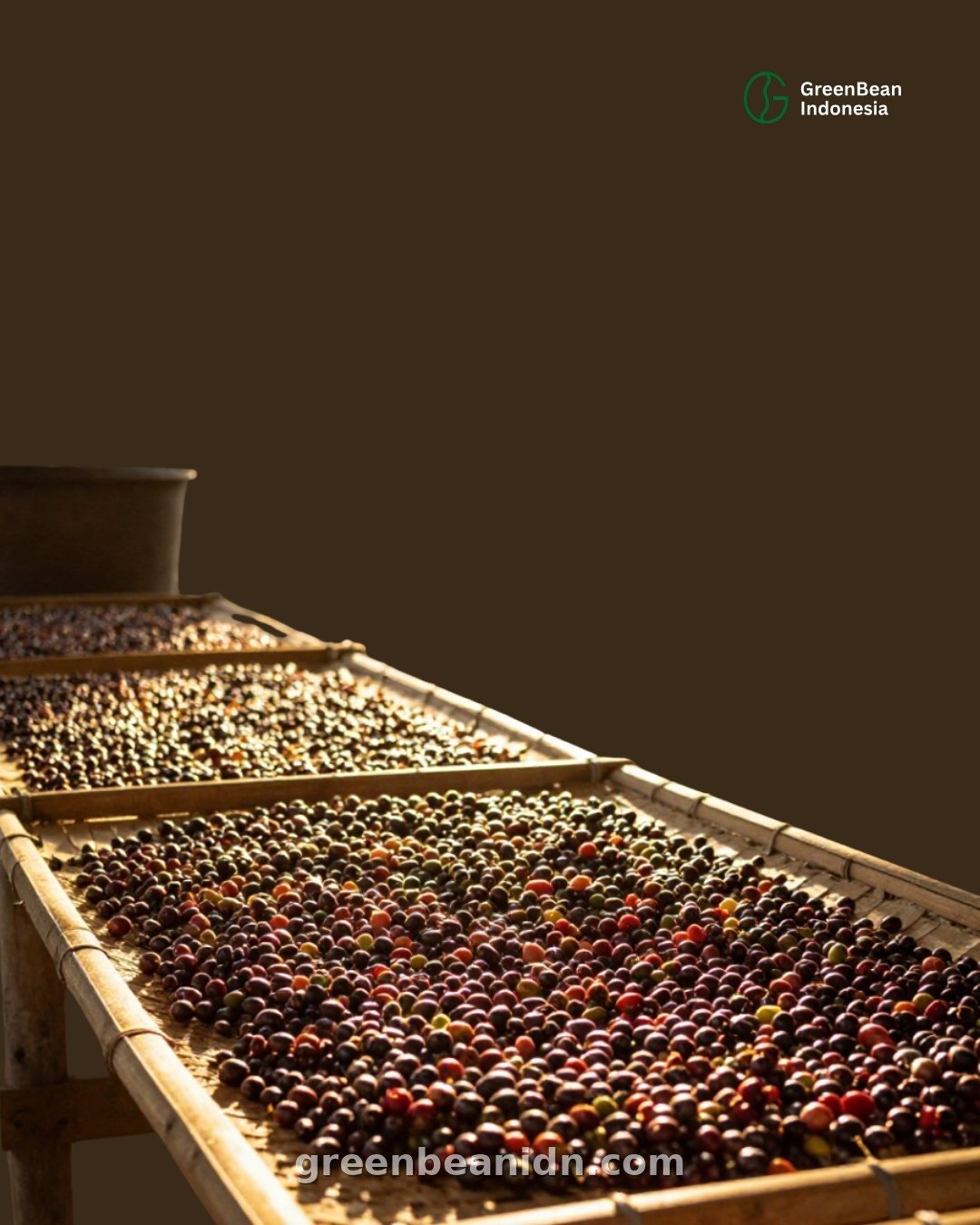
Across all SNI grades, the maximum moisture content is set at 12.5% for export. This is measured using calibrated moisture meters at the time of grading and again before shipment.
In practice, specialty and Fine Robusta lots are typically exported at 10.5–12.5% moisture — tight enough to ensure stability during ocean freight without being so dry that the bean becomes brittle or loses flavour development. All lots from GreenBean Indonesia are moisture-tested at point of shipment and the result is documented on the lot data sheet.
Where Does Fine Robusta Fit?
The SNI grading system is a physical quality standard — it measures what the bean looks like, not what it tastes like. This is an important distinction for specialty buyers.
A lot can achieve Grade 1 SNI status (defect value 0–11) and still taste like ordinary commodity Robusta if it was grown at low altitude, harvested without selectivity, or processed carelessly. Conversely, a lot with genuine Fine Robusta cup quality will almost always also achieve Grade 1 or Grade 2 SNI status — because the same care that goes into producing quality cup results (selective harvesting, proper processing, controlled drying) also eliminates most physical defects.
Fine Robusta, as assessed under CQI's Q Robusta programme, is graded on cup quality attributes — fragrance, flavour, aftertaste, salt/acid balance, bitter/sweet ratio, mouthfeel, and cleanliness. These are entirely separate from SNI physical defect counting. The two systems complement each other: SNI tells you the coffee is physically clean; Fine Robusta certification tells you it's also cupped and scored for specialty-level flavour.
What GreenBean Indonesia Provides
All lots from GreenBean Indonesia are physically graded to SNI Grade 1 or Grade 2 standards — defect value ≤25 per 300g sample, moisture 10.5–12.5%, screen size 15–17. Every commercial shipment is accompanied by a full lot data sheet documenting these figures.
We are transparent about what we can and cannot claim: our lots are physically graded to high SNI standards, and we are in the process of having them formally assessed by a certified R Grader for Fine Robusta cup scoring. Cupping scores are available on request based on our internal assessments; verified scores will be published as they become available.

Key Takeaways for Buyers
Grade 1 is the benchmark for quality sourcing. If you are purchasing Indonesian green coffee for specialty or commercial specialty use, insist on SNI Grade 1 or Grade 2 documentation as a baseline.
SNI grade is not the same as specialty quality. Physical cleanliness is necessary but not sufficient. Request cupping data and lot data sheets alongside SNI documentation.
Moisture matters as much as defects. Even a Grade 1 lot stored poorly can develop moisture-related defects in transit. GrainPro inner bag packaging significantly reduces this risk on ocean freight.
Transparency is the differentiator. A credible Indonesian supplier should be able to provide SNI grade documentation, moisture readings, screen size data, and ideally cupping notes — for every lot, not just on request.